跳至主要内容

Rubber Din Abrasion Tester Instructions for Use and Caution

Rubber Din Abrasion Tester Instructions for Use and Caution

Under a specified contact pressure and a given area, the sample is held at a certain angle to the sandpaper and the amount of wear produced by rubbing the sample on a certain grade of sandpaper is measured.


Sandpaper is wrapped around the surface of the drum, and the sample is pressed against the drum with the sandpaper, causing the sample to move laterally along the drum. The wear occurs at one end of the cylindrical sample, the mass loss of the sample is measured and the volume wear is calculated from the density of the sample.
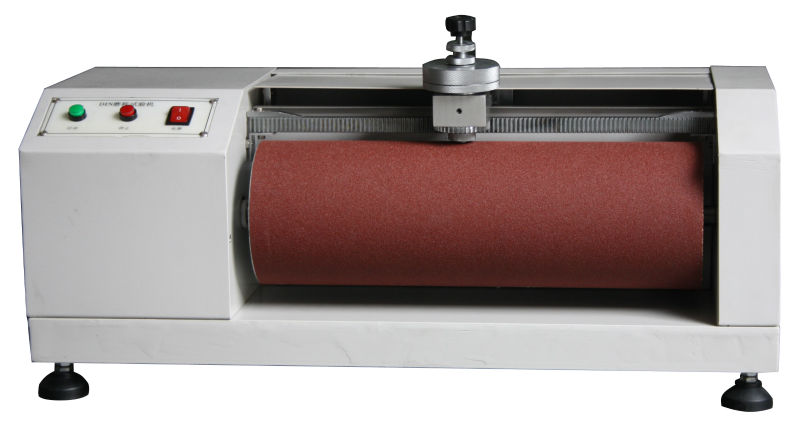
Rubber Din Abrasion Tester

The tester meets the requirements of DIN-53516, ISO/DIS-4649, BS 903 part 9 and GB-9867.


Test piece load:2.5n±0.2 n5n±0.2n

Roller diameter:φ(150±0.2)mm

Roller length:460mm

Stroke:40m(84rpm)/20m(42rpm)

Wear speed:0.32m/sec

Volume(approx.) :70cm × 30cm × 30cm

Weight(approx.) :50kg

Power supply:1∮ AC 220 volt 3A (according to the country or name)


Instructions for use:

1.Power conditions::Please configure the correct power supply according to the label on the nameplate of the machine.

The input voltage error range should be within 10%, and the machine should be properly grounded to prevent the machine.

评论

此博客中的热门博文

Tinuvin 1130: An Excellent UV Absorber

 In the field of the chemical industry, UV absorbers play a crucial role, particularly in protecting materials from UV damage. Today, we will delve into a highly regarded UV absorber—Tinuvin 1130. Tinuvin 1130 : chemical name: 3-(3-(2H-benzotriazole-2-yl)-4-hydroxy-5-tert-butyl phenyl)propionic acid polyethylene glycol 300 ester; CAS login number: 104810-48-2. This product is an exceptional UV absorber that offers numerous benefits due to its unique properties. One of the standout features of Tinuvin 1130 is its excellent weather resistance. It has a strong ability to absorb ultraviolet rays, particularly those with wavelengths ranging from 290-400nm. This effectively prevents coatings, plastics, rubber, and other materials from being damaged by UV rays, thereby maintaining the performance and appearance stability of these materials and extending their service life. In addition, Tinuvin 1130 exhibits good compatibility. It is easy to emulsify in water-based systems and can be...

Air-cooled Xenon Lamp Aging Tester

  The air-cooled xenon lamp aging tester is a device that uses an air-cooled system to dissipate heat and a xenon lamp to simulate ultraviolet light, visible light and infrared light in natural sunlight to perform accelerated aging tests on materials. It is commonly used in industries such as automobiles, coatings, plastics, rubber, and textiles. It can evaluate the aging resistance of materials under the combined effects of long-term light, temperature, humidity and other environmental factors in a relatively short period of time, helping companies improve product quality, extend service life, and optimize product anti-aging formulas and processes. Structural composition:  The main body is a test chamber, equipped with a xenon lamp and a matching optical filter system to simulate sunlight of different wavelengths, as well as temperature, humidity, lighting time and other control and adjustment devices, as well as an observation window and a sample rack. Working principle: The...

The Structure of Hexapod Tumble Tester

The Hexapod Tumbler Tester is a popular apparatus used in the evaluation of the appearance retention of carpets. Drum – constructed of Nylon or other like material and capped by a lid that is secured by a latching device. The drum and lid have a locating groove to hold the specimen backing sheet flat to the inner wall of the drum. A photograph of a typical drum is show in Photograph 1 and Photograph 2. The drum dimensions are:   Internal Diameter: 12 ± 0.18 in. (302 ± 5mm) Wall Thickness :0.3 in. approx. (8 mm approx.) Internal Depth: 8.2 ± 0.2 in. (207 ± 5 mm)  Driving System - cradles the drum on rollers and keeps the axis of the drum level, and rotates the drum at 35 ± 2 rpm (3.6 ± 0.2 rad/s). The driving direction reverses after approximately 500 revolutions.  After the 500 rotations the unit will stop and stand stationary for approximately 5 to 15 seconds, then begin rotating in the opposite direction. After 2000 rotations the unit will stop and w...