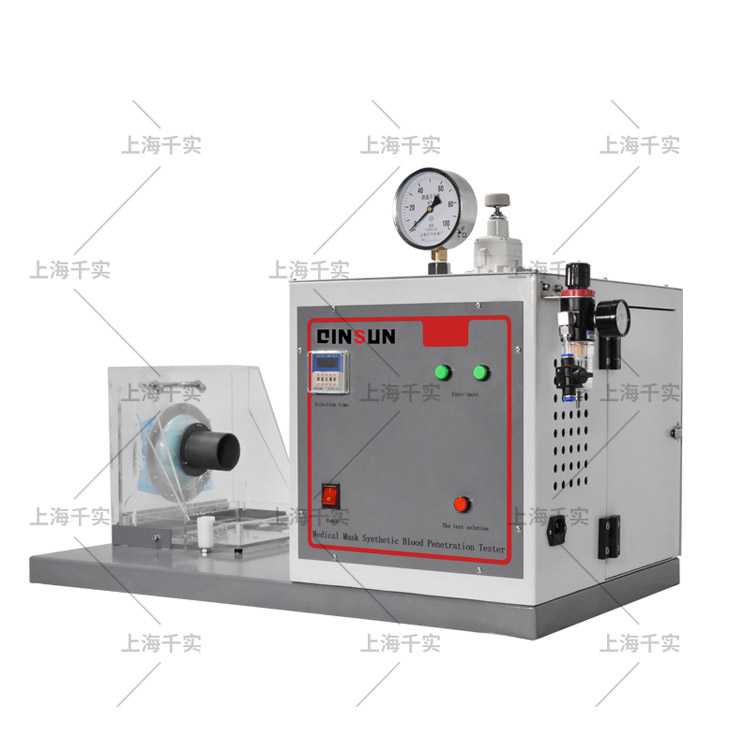
Surgical Masks Synthetic Blood Penetration Resistance Tester
Medical Face Mask Synthetic Blood Penetration Resistance Tester is mainly used in the blood penetration test of masks, which ensures that medical masks can have enough protection to prevent the penetration of blood after splashing from bringing danger to users. It is an essential part of mask test, especially for medical masks.
Face Mask Synthetic Blood Penetration Resistance Tester can be used not only to detect synthetic blood penetration resistance of medical masks, but also to detect other textile coating materials. When in use, it can be used to detect different directions only by adjusting the appropriate parameters, thus improving the practicability and working efficiency of the equipment to the greatest extent.
Mask Synthetic Blood Penetration Tester Standards:
GB 19083-2010 Technical requirements of medical face masks - Anti-penetration property of 5.5 synthetic blood.
YY/T 0691-2008 Clothing for protection against infectious agents-Medical face masks - Test method for resistance against penetration by synthetic blood (fixed volume, horizontally projected)
YY 0469-2011 Technical requirements of medical face masks– Blood penetration test apparatus.
ISO 22609:2004 Clothing for protection against infectious agents - Medical face masks - Test method for resistance against penetration by synthetic blood (fixed volume, horizontally projected)
ASTM F1862-07Standard Test Method for Resistance of Medical Face Masks to Penetration by Synthetic Blood (Horizontal Projection of Fixed Volume at a Know Velocity)
parameter:
Medical Face Mask Synthetic Blood Penetration Resistance Tester is mainly used in the blood penetration test of masks, which ensures that medical masks can have enough protection to prevent the penetration of blood after splashing from bringing danger to users. It is an essential part of mask test, especially for medical masks.
Face Mask Synthetic Blood Penetration Resistance Tester can be used not only to detect synthetic blood penetration resistance of medical masks, but also to detect other textile coating materials. When in use, it can be used to detect different directions only by adjusting the appropriate parameters, thus improving the practicability and working efficiency of the equipment to the greatest extent.
Mask Synthetic Blood Penetration Tester Standards:
GB 19083-2010 Technical requirements of medical face masks - Anti-penetration property of 5.5 synthetic blood.
YY/T 0691-2008 Clothing for protection against infectious agents-Medical face masks - Test method for resistance against penetration by synthetic blood (fixed volume, horizontally projected)
YY 0469-2011 Technical requirements of medical face masks– Blood penetration test apparatus.
ISO 22609:2004 Clothing for protection against infectious agents - Medical face masks - Test method for resistance against penetration by synthetic blood (fixed volume, horizontally projected)
ASTM F1862-07Standard Test Method for Resistance of Medical Face Masks to Penetration by Synthetic Blood (Horizontal Projection of Fixed Volume at a Know Velocity)
parameter:
| Items | Parameters |
| Injection distance | 300mm~305mm, adjustable |
| Nozzle diameter | 0.84mm |
| Jet velocity | 450cm/s,550cm/s,635cm/s |
评论
发表评论