跳至主要内容

Artificial blood vessel compression rupture strength tester

Artificial blood vessel compression rupture strength tester

To determine the pressure of water penetration through blood vessels, the instrument should include devices that can keep the sample sealed until leakage occurs. A suitable pressure transducer is also required.
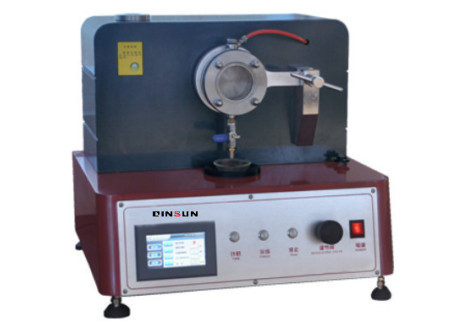
medical clothing blood penetration resistance tester.jpg

Third, the test standard: YY0500-2021, GB/T7742


IV, Technical parameters.


Operation interface: Simplified Chinese/English


V. Test standard: YY0500-2021,GB/T7742


Pressure sensor: 0-10MPA (test can be set by software)


Fixture: Luer joint or according to customer's choice


Time timer: touch screen display


Clamp: 1 set


Safety cover 1 set:1m


Product net weight: 15kg


Dimension: 430×290×500(mm)


Power source: AC90V-240V/50Hz (adaptive wide voltage)


Whole machine power: 70W


Programmable controller: PLC control system


Touch screen: 7-inch Velcom color touch screen


Force measuring mechanism: built-in


Printer: Embedded printer


1 Principle


The sample is dilated by any of the following methods:


a) filling the vessel directly with fluid;


b) placing the blood vessel outside the balloon to be constantly measured by the changing pressure added to the balloon until the sample ruptures.

评论

此博客中的热门博文

Tinuvin 1130: An Excellent UV Absorber

 In the field of the chemical industry, UV absorbers play a crucial role, particularly in protecting materials from UV damage. Today, we will delve into a highly regarded UV absorber—Tinuvin 1130. Tinuvin 1130 : chemical name: 3-(3-(2H-benzotriazole-2-yl)-4-hydroxy-5-tert-butyl phenyl)propionic acid polyethylene glycol 300 ester; CAS login number: 104810-48-2. This product is an exceptional UV absorber that offers numerous benefits due to its unique properties. One of the standout features of Tinuvin 1130 is its excellent weather resistance. It has a strong ability to absorb ultraviolet rays, particularly those with wavelengths ranging from 290-400nm. This effectively prevents coatings, plastics, rubber, and other materials from being damaged by UV rays, thereby maintaining the performance and appearance stability of these materials and extending their service life. In addition, Tinuvin 1130 exhibits good compatibility. It is easy to emulsify in water-based systems and can be...

Medical Mask Synthetic Blood Penetration Tester

Surgical Masks Synthetic Blood Penetration Resistance Tester Medical Face Mask Synthetic Blood Penetration Resistance Tester is mainly used in the blood penetration test of masks, which ensures that medical masks can have enough protection to prevent the penetration of blood after splashing from bringing danger to users. It is an essential part of mask test, especially for medical masks. Face Mask Synthetic Blood Penetration Resistance Tester can be used not only to detect synthetic blood penetration resistance of medical masks, but also to detect other textile coating materials. When in use, it can be used to detect different directions only by adjusting the appropriate parameters, thus improving the practicability and working efficiency of the equipment to the greatest extent. Mask Synthetic Blood Penetration Tester  Standards: GB 19083-2010 Technical requirements of medical face masks - Anti-penetration property of 5.5 synthetic blood. YY/T 0691-2008 Clothing for protection agai...

Ink Abrasion Tester For Ink Layer Abrasion Test

        Abrasion resistance of ink layer is one important parameter that is used to evaluate the printing quality. If the abrasion resistance of the ink layer is poor, the printed words on the paper or paperboard may become illegible and the part with printed area may be abraded in transportation, storage or in use.                   As a result, the printed words will be not able to be read by the customers, which cause inconvenience or misunderstanding and thus the product image would be compromised. Therefore, it is necessary for the manufacturers to test the abrasion resistance of the ink layer on the paper or paperboard before use.         Often during the shipping or handling process, printed products will be exposed to a degree of abrasion to its surface. Regardless of quality or perfection of the printed product, a scuffed, rubbed off or scratched surface would render it a print defect...