跳至主要内容

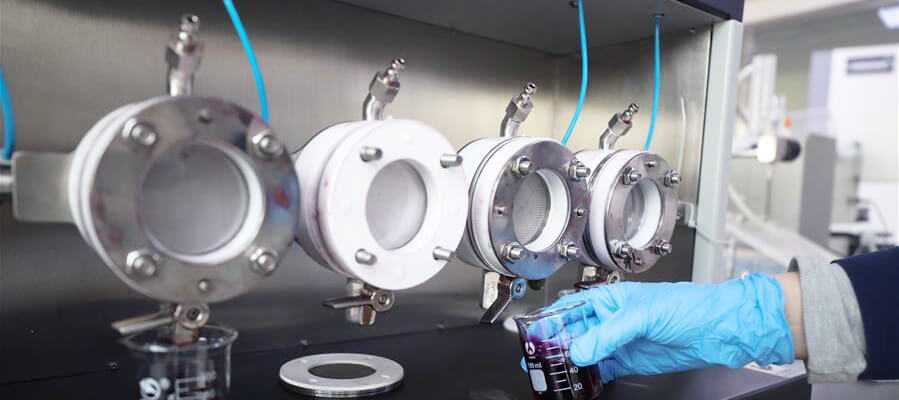
Synthetic blood penetration tester

 Synthetic Blood Penetration Tester is used for the determination of resistance of penetration by the synthetic blood under the different levels of test pressure to medical protective clothing.

 
A specimen medical face mask is supported on an apparatus. A fixed volume of synthetic blood is sprayed horizontally at the specimen mask to simulate the scenario of a mask being splashed by a punctured blood vessel. The volume of fluid, distance to impact, orifice size and fluid velocity are defined in their methods and intended to be consistent with this health care scenario.
 
This test is required by ASTM F2100 and is tested in compliance with ASTM F1862, ASTM F2100, EN 14683, and ISO 26609. Nelson Labs’ highly experienced staff provides a one-stop shop for all ASTM F2100 and EN 14683 testing.
 
Feature:
1.With one or four working position, can test one or four specimen simultaneously.
2.Single-chip microcomputer automatic control, automatic timing, automatic alarming once test finished.
3.Protective clothing blood penetration tester with mechanical pressure meter, easy for checking.
4.With HMI configuration, real-time display of pressurized pressure by touch screen.
5.Each working position is equipped with independent pressure monitored display.
6.Adopt with programmable throttle valve for pressure apply, to make sure the rate of pressurized is not excess 3.5kPa/s.
7.Medical protective clothing blood penetration testing machine using 13.6N.m ratchet wrench for specimen installation, torque force is controllable.
 
Standards:
ASTM F903, ASTM F1670, ASTM F1671/F1671M , YY/T0700, GB19082, ISO16603, ISO 16604, IS 16545, IS 16546
 
Specifications:
Pressure range: (05~ 25) kPa
Test area: 28.26cm?
Specimen size: 75 * 75 mm
Power: 220 V, 50 Hz, 50 W
Weight: 30 Kg
Dimensions: 560 * 460 * 480 mm (L x W x H)
Packaging info.: 720 * 620 * 730 mm (L x W x H), 57 Kg



评论

此博客中的热门博文

Tinuvin 1130: An Excellent UV Absorber

 In the field of the chemical industry, UV absorbers play a crucial role, particularly in protecting materials from UV damage. Today, we will delve into a highly regarded UV absorber—Tinuvin 1130. Tinuvin 1130 : chemical name: 3-(3-(2H-benzotriazole-2-yl)-4-hydroxy-5-tert-butyl phenyl)propionic acid polyethylene glycol 300 ester; CAS login number: 104810-48-2. This product is an exceptional UV absorber that offers numerous benefits due to its unique properties. One of the standout features of Tinuvin 1130 is its excellent weather resistance. It has a strong ability to absorb ultraviolet rays, particularly those with wavelengths ranging from 290-400nm. This effectively prevents coatings, plastics, rubber, and other materials from being damaged by UV rays, thereby maintaining the performance and appearance stability of these materials and extending their service life. In addition, Tinuvin 1130 exhibits good compatibility. It is easy to emulsify in water-based systems and can be...

Air-cooled Xenon Lamp Aging Tester

  The air-cooled xenon lamp aging tester is a device that uses an air-cooled system to dissipate heat and a xenon lamp to simulate ultraviolet light, visible light and infrared light in natural sunlight to perform accelerated aging tests on materials. It is commonly used in industries such as automobiles, coatings, plastics, rubber, and textiles. It can evaluate the aging resistance of materials under the combined effects of long-term light, temperature, humidity and other environmental factors in a relatively short period of time, helping companies improve product quality, extend service life, and optimize product anti-aging formulas and processes. Structural composition:  The main body is a test chamber, equipped with a xenon lamp and a matching optical filter system to simulate sunlight of different wavelengths, as well as temperature, humidity, lighting time and other control and adjustment devices, as well as an observation window and a sample rack. Working principle: The...

The Structure of Hexapod Tumble Tester

The Hexapod Tumbler Tester is a popular apparatus used in the evaluation of the appearance retention of carpets. Drum – constructed of Nylon or other like material and capped by a lid that is secured by a latching device. The drum and lid have a locating groove to hold the specimen backing sheet flat to the inner wall of the drum. A photograph of a typical drum is show in Photograph 1 and Photograph 2. The drum dimensions are:   Internal Diameter: 12 ± 0.18 in. (302 ± 5mm) Wall Thickness :0.3 in. approx. (8 mm approx.) Internal Depth: 8.2 ± 0.2 in. (207 ± 5 mm)  Driving System - cradles the drum on rollers and keeps the axis of the drum level, and rotates the drum at 35 ± 2 rpm (3.6 ± 0.2 rad/s). The driving direction reverses after approximately 500 revolutions.  After the 500 rotations the unit will stop and stand stationary for approximately 5 to 15 seconds, then begin rotating in the opposite direction. After 2000 rotations the unit will stop and w...